NIGERIA NEEDS A MILITARY RESERVE FORCE: A Missing Link in National Security
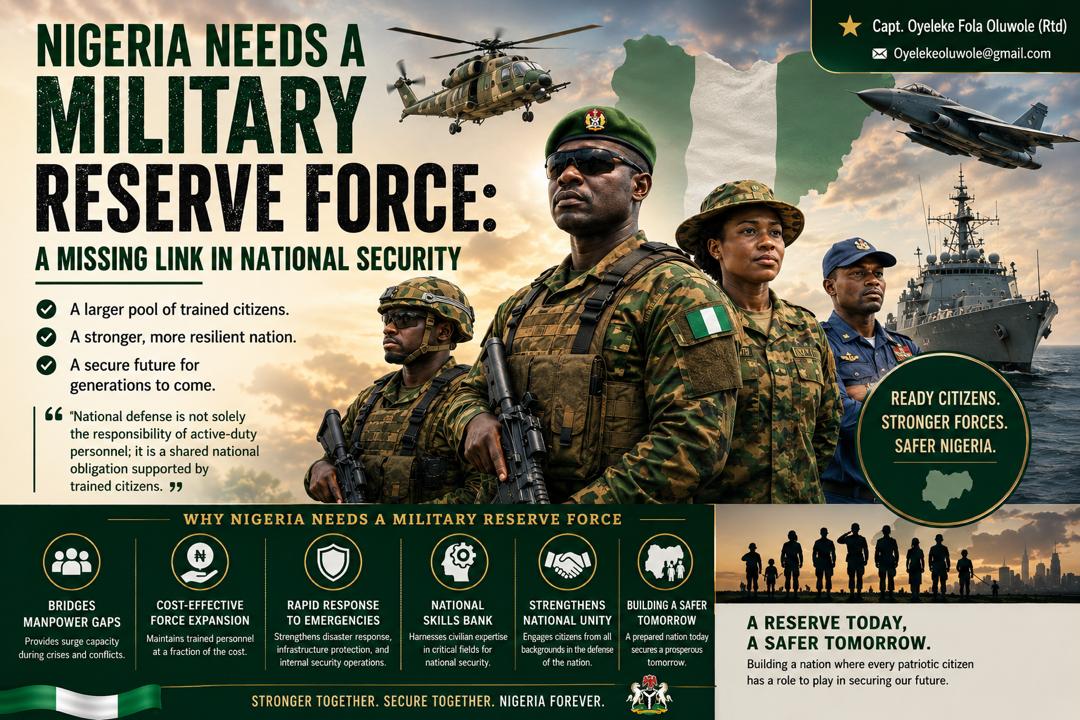
By Captain Oyeleke Folajuwon Oluwole (Rtd.)
As Nigeria continues to confront terrorism, banditry, kidnapping, oil theft, piracy, communal violence, and an increasingly complex security environment, one critical question deserves urgent national attention: does Nigeria have sufficient manpower to meet its present and future security challenges?
The answer is straightforward: no.
While discussions often focus on military funding, weapons procurement, intelligence gathering, and the proposed creation of state police, far less attention has been paid to a glaring weakness within Nigeria’s security architecture—the absence of a robust military reserve force.
The Armed Forces of Nigeria have performed admirably under extraordinarily difficult circumstances. Yet they remain overstretched. Military personnel are deployed across nearly every region of the country, often carrying out prolonged internal security operations in addition to their constitutional responsibility of defending the nation’s territorial integrity. This operational tempo places enormous pressure on personnel, equipment, and resources.
For a nation of more than 230 million people, Nigeria’s active-duty military alone cannot realistically provide the manpower depth required to address multiple security threats simultaneously. Modern security challenges require not only capable standing forces but also a trained reserve component that can be mobilized when circumstances demand.
Many of the world’s most effective security systems are built upon this principle. Countries such as the United States, Israel, the United Kingdom, and India maintain reserve formations that serve as force multipliers during emergencies, conflicts, natural disasters, and homeland security operations. These nations understand that national defense is not solely the responsibility of active-duty personnel; it is a shared national obligation supported by trained citizens.
Nigeria should adopt a similar approach.
A military reserve force would allow the country to expand its available manpower without incurring the enormous costs associated with maintaining a significantly larger standing military. Reservists would live and work within civilian society while receiving periodic military training and remaining available for mobilization when required.
Such a system would be particularly valuable in a country like Nigeria, where thousands of highly skilled professionals possess expertise directly relevant to national security. Doctors, engineers, cybersecurity specialists, pilots, intelligence analysts, logistics professionals, telecommunications experts, and drone operators could all contribute to national defense through reserve service while continuing their civilian careers.
This approach would create what may be described as a national strategic talent pool—a reservoir of trained personnel that can be activated during periods of national need.
The benefits extend beyond warfare.
Every year, Nigeria faces natural disasters, flooding, humanitarian crises, and emergencies that require rapid government response. A properly trained reserve force could support disaster management agencies, protect critical infrastructure, assist in evacuation and relief efforts, and reinforce security operations during periods of heightened threat.
Equally important is the issue of recruitment.
Like many countries around the world, Nigeria faces challenges in attracting and retaining sufficient military personnel. Many patriotic citizens are willing to serve their country but may be unwilling or unable to commit to full-time military careers. A reserve system offers an alternative pathway for service, enabling citizens to contribute meaningfully to national security without abandoning their professions or businesses.
Beyond operational benefits, a reserve force would strengthen the relationship between citizens and the military. It would promote patriotism, civic responsibility, and national cohesion by providing Nigerians from every region, ethnic group, and profession an opportunity to participate directly in national defense.
A practical model already exists.
Nigeria could establish reserve components within the Army, Navy, and Air Force. Former military personnel could form the immediate-response reserve, while trained civilians and specialized professionals could constitute a broader operational reserve. Monthly training periods, annual exercises, and clearly defined mobilization procedures would ensure readiness without imposing excessive financial burdens on government.
The establishment of state police, currently under national consideration, would represent a significant step toward strengthening local law enforcement and community security. However, state police alone will not solve Nigeria’s broader manpower challenges. A military reserve force would complement ongoing security reforms by providing strategic depth, surge capacity, and resilience during national emergencies.
Furthermore, as Nigeria considers the creation of a Department of Homeland Security or similar homeland security structures at the federal and state levels, a reserve force could become a critical component of national resilience. Reservists could support disaster response, critical infrastructure protection, cybersecurity initiatives, border security, emergency management, and community preparedness efforts, thereby strengthening the nation’s overall security architecture.
Security in the twenty-first century requires more than weapons and uniforms. It requires adaptability, preparedness, and the ability to rapidly mobilize trained personnel when circumstances demand.
Nigeria does not necessarily need one of the largest standing militaries in Africa. What it needs is a larger pool of trained citizens who can be called upon when the nation requires their service.
The establishment of a military reserve force would not merely increase numbers; it would strengthen national readiness, reduce pressure on active-duty troops, harness civilian expertise, improve recruitment outcomes, and create a more sustainable security architecture for the future.
At a time when Nigeria is rethinking its security framework and searching for innovative solutions to evolving threats, the creation of a military reserve force should no longer be viewed as an option. It should be regarded as a strategic necessity.
A Word to Our Serving Military Personnel
As Nigeria debates security reforms, increased recruitment, improved welfare, and the establishment of a military reserve force, it is important to recognize that no reform can succeed without the professionalism, discipline, and commitment of the men and women currently serving in uniform.
To the officers and soldiers, ratings, airmen and airwomen of the Armed Forces of Nigeria, the nation owes a debt of gratitude for your sacrifices. Every day, you operate in challenging environments, often separated from your families, confronting threats to our collective peace and security. Your courage and dedication remain the backbone of Nigeria’s defense.
Yet the security challenges of the twenty-first century demand more than bravery alone. They require continuous learning, innovation, intelligence-driven operations, technological adaptation, and unwavering adherence to the highest standards of military professionalism. Modern warfare and national security are increasingly shaped by information, cyber capabilities, intelligence fusion, and public trust.
As guardians of the nation, you must continue to uphold the values of integrity, discipline, accountability, and respect for the rule of law. The confidence of the Nigerian people is one of the Armed Forces’ greatest strategic assets and must be protected through professional conduct and exemplary service.
The future of Nigerian security will require stronger partnerships between the military, intelligence agencies, law enforcement agencies, local communities, state security institutions, and emerging reserve components. As these reforms unfold, the Armed Forces must remain at the forefront of building a modern, agile, and responsive security architecture capable of meeting present and future threats.
History will not only remember the battles won against terrorism, banditry, and criminality. It will also remember the institutions strengthened, the citizens protected, and the legacy left behind for future generations.
Nigeria believes in its Armed Forces. The nation looks to you not only as defenders of our sovereignty but as leaders in the ongoing transformation of our national security framework. Continue to serve with honor, courage, professionalism, and an unwavering commitment to the Federal Republic of Nigeria.
About the Author
Captain Oyeleke Folajuwon Oluwole (Rtd.) is a U.S.-trained security professional, U.S. Army combat veteran, private investigator, and doctoral candidate in Strategic Leadership at Liberty University, Lynchburg, Virginia. He writes on national security, homeland security, intelligence, defense policy, and public sector reform.









Post Comment